TATT Chat Recap – October 2025

TATT Chat Recap – October 2025

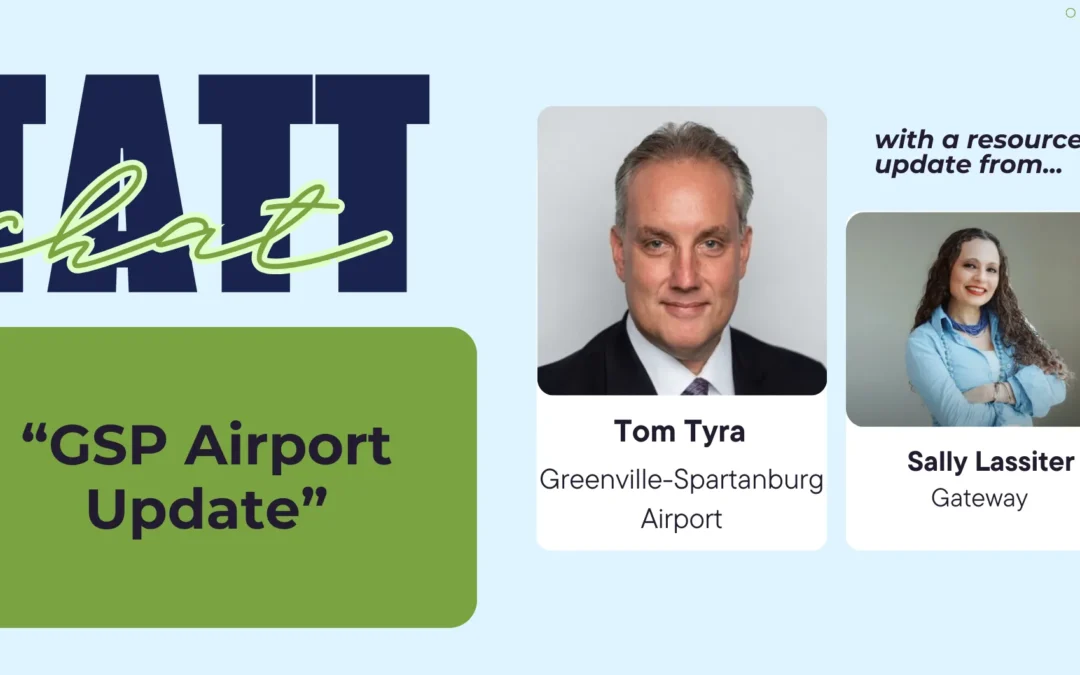
Oct. 15, 2025, marks the 67th anniversary of the first flight at GSP International Airport in 1958. VP/Chief Marketing & Communications Officer, Tom Tyra, informed us about several upcoming projects concerning the airport.

Three million passengers travel through GSP every year. To accommodate this, the airport has made several improvements to make the visitor experience more seamless. One of the largest upcoming projects is the repaving of runway 4/22. 6,500 feet of runway will be repaved with asphalt, in addition to 11,001 feet of shoulder area, and the runway safety areas. It has been 17 years since the runway was paved, and 30 years since the shoulder has been addressed. The project is set to take place in 2026 in three phases starting on July 27-Sept. 4 with nightly runway closures. There will be two 72-hour full runway closures Sept. 11-13 and Sept. 18-20. The last phase is expected to take place from Sept. 14-Nov. 12 with nightly closures. This is the most efficient way to complete this project as it would take over 200 nights of partial closures to complete runway work.

Roadways into the airport have been upgraded as well as the addition of lanes in front of the terminal, increasing traffic efficiency. A new 1,500 space parking garage is expected to be fully operational by December 2025. Two passenger boarding bridges for gates A0 and B5 have been added to handle the increase in airport traffic. The facility is also updating all the seats, adding 20% seating capacity with charging stations. This is projected to be completed by the end of 2025. For more information regarding airport projects please visit https://gspairport.com/trip/.

During our TATT Chat, Gateway SC presented us with a resource update. Oct. 10, 2025, is World Mental Health Day. One in five adults have a mental health issue. To help combat this, Gateway utilizes the Clubhouse International model which focuses on building connections and viable skills. This is an excellent standard because it is internationally recognized and more cost effective than other treatment programs. For more information about how to support Gateway SC please visit https://gateway-sc.org/support-gateway/.

TATT CHAT Recap – September 2025

TATT CHAT Recap – September 2025

Our Sept. 11, 2025, TATT Chat focused on homelessness in the upstate. Keynote speakers Hannah Jarratt from A Place to Call Home, and Cody Carver from Greenville Together updated us with statistics, 2025 progress, and ways to support their mission.

A Place to Call Home is a Spartanburg based collective focused on sustainable housing. As of Jan. 1, 2025, there were 288 homeless people in Spartanburg County. Unfortunately, APTCH estimates that 65% of homelessness goes unreported, making the number of unhoused people significantly higher. Prevention, service, and housing are crucial steps in APTCH’s mission. A Way Home is a program operated by APTCH and The Faith Initiative to End Child Poverty. Around 90 days ago, they opened a family shelter in Spartanburg County. This filled a huge void as there were no family shelters currently available in the area. “We envision a Spartanburg County where homelessness is recognized as a solvable problem and where everyone has a safe, secure place to call home.”

Greenville Together is collaborative effort supported by United Way of Greenville, United Housing Connections, United Ministries, and the Triune Mercy Center. In Jan. 2025, Greenville Together estimated that there were 739 homeless people in Greenville County. Once again, the number is likely larger as homelessness often goes unreported. Greenville Together is utilizing a one-year, six-step action plan that includes accountability, public education, and training. The goal is to house 80 unsheltered households by the end of 2025. They also have a three-year, four-step comprehensive plan aimed at reducing homelessness amongst all populations. One of the ways to support Greenville Together is through their street counts. These are held on the last Thursday of the month. To participate in a street count email Cody Carver at ccarver@greenvilletogether.org.

For more information about A Place to Call Home and Greenville Together watch our Sept. TATT Chat and visit the websites below.

A Place to Call Home
Greenville Together 

“The Mental Health Crisis Generations in the Making”

By Dean Hybl

Growing up in the 1970s and 1980s gave me countless memories I cherish. Yet one area I wish had been different was how society approached mental health and personal struggles. Back then, women were often expected to step away for “a good cry,” while men were allowed the occasional outburst—sometimes fueled by alcohol, sometimes by stress—without much concern. Children were left to process these behaviors on their own, while being told never to show weakness.

Over the past 40 years, our culture has begun to shift. We talk more openly about mental health, but even today in 2025, stigma remains, and resources are still stretched far too thin. Recognizing this need, Ten at the Top, the SC Department of Public Health Upstate Region, and the SC Office of Rural Health have partnered with more than 100 organizations within the Behavioral Health field to grow the collective capacity of behavioral health services across the Upstate. This work, highlighted during the recent Resilient Upstate Behavioral Health Collaborative rollout, shed light on sobering statistics.

In our region, more than 16% of adults report experiencing poor mental health at least half of every month. Over a quarter have been diagnosed with depression. Suicide—an issue I first encountered in high school when a classmate’s younger brother took his own life—remains devastatingly prevalent. At that time, students were told they should “speak up” when they struggled but offered little guidance or support if they did. The stigma was heavy, especially for men, who were expected to suppress emotion and just “get over it”. It’s no surprise, then, that men continue to die by suicide at far higher rates than women.

The numbers are stark. According to the SC Department of Public Health, the male suicide rate in the Upstate is 28.3 deaths per 100,000—nearly four times the female rate of 7.2. Both figures exceed state and national averages. Even more troubling, suicide is now the second leading cause of death for Upstate residents ages 10 through 34, behind only accidental injuries. It is also disproportionately high among men over 75 and veterans. These deaths are preventable, and we must treat them as such.

Encouragingly, new tools and resources are being developed to change the narrative. At the rollout event, the collaborative unveiled a workplace toolkit to help employers support employees and families, along with stigma-reduction programs to spark courageous conversations. They also introduced the Behavioral Health Professional Pipeline, a hub highlighting 16 different career paths in behavioral health, aimed at inspiring young people to enter this critically important field. DREAMS Workshops are also helping foster Recovery Friendly Workplaces, ensuring both businesses and communities benefit from healthier environments.

My hope is that when people look back on this decade 50 years from now, they’ll see a turning point: the moment when our culture finally began to treat mental health as openly and seriously as physical health. By dismantling stigma, promoting resources, and encouraging honest conversations, we can create an Upstate—and a future—where no one suffers in silence, and where preventable deaths are truly prevented.

(You can check out the Resilient Upstate Resources at: https://tenatthetop.org/resilient-upstate-behavioral-health-initiative/)

Supporting mental health and well-being in the workplace is an important employee retention strategy. Please Join us for one of the Turning Resources Into Actionable Behavioral Health Workplace Practices Workshops. We are limiting each to a maximum of 20 attendees to ensure opportunities for discussion.

October 15 – 9:30-11:30 a.m. – Park 37 Complex (150 Executive Center Dr., Greenville, SC 29615) – Link to Register

November 5 – 9:30-11:30 a.m. – Park 37 Complex (150 Executive Center Dr., Greenville, SC 29615) – Link to Register

“Striving to Achieve a Great Society”

“Striving to Achieve a Great Society”

by Dean Hybl, Executive Director, Ten at the Top

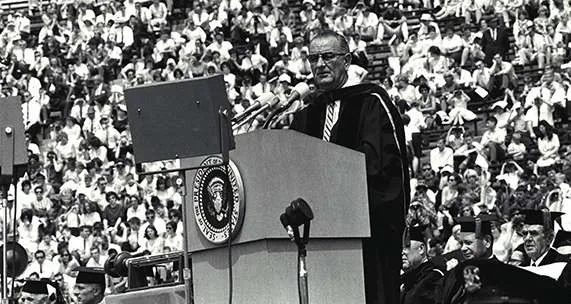
It was in a speech at the University of Michigan 71 years ago, on May 22, 1964, that President Lyndon Johnson first outlined strategies to address poverty, racial inequality, and other social issues in the United States in an overall domestic agenda that would become known as the “Great Society”.

Among the programs and legislation developed as part of the agenda were the:

  • Economic Opportunity Act of 1964: Created the Office of Economic Opportunity, including Job Corps and Head Start.
  • Social Security Act Amendments (1965): Created Medicare and Medicaid.
  • Elementary and Secondary Education Act (1965): Expanded federal funding for education.
  • Civil Rights Act of 1964: Outlawed discrimination based on race, color, religion, sex, or national origin.
  • Voting Rights Act of 1965: Eliminated discriminatory voting practices.
  • Department of Housing and Urban Development: Established to address housing issues.

While like most people I have heard the “Great Society” referenced throughout the years, I didn’t really understand the totality of the effort and its goal to end poverty in the United States until recently reading the book “An Unfinished Love Story” by author and historian Doris Kearns Goodwin.

In the book, Kearns-Goodwin walks through the history of the 1960s using the more than 300 boxes of papers and memorabilia compiled by her husband, Dick Goodwin. Goodwin was a speechwriter and staff member in the White House for both John F. Kennedy and Lyndon Johnson.

It was, in fact, Goodwin who coined the phrase “Great Society” though he was just one of several advisors who helped Johnson frame the agenda.

One thing that struck me when reading about the early development of the “Great Society” agenda was the clear belief by Johnson and those around him that the effort could successfully end poverty across the United States.

As I think about what has evolved over the last 71 years and specifically where we are as a community and nation today, it strikes me that while the result of the work of Johnson and others helped create some measurable positive impacts, we are still dealing with most of the issues identified in the “Great Society” today.

The three pillars of the Great Society program were education, employment and healthcare. In addition to the development of the programs I highlighted earlier, it also created the National Endowment for the Arts, called for support for mental illness, and set the groundwork for the creation of the Environmental Protection Agency in 1970 during the administration of President Richard Nixon.

When looking at the work that Ten at the Top has been doing to support economic vitality and quality of life in the Upstate region over the last 15 years, I can’t help but see the connections between the idea of a “Great Society” where every person has the opportunity to thrive and the idea of Ten at the Top to build the collective capacity of businesses, organizations and communities across our Upstate region.

Since 2010, Ten at the Top has engaged Upstate leaders around such a wide array of issues that all are part of the goal of making this a better place for every person living in the region.

From air quality, transportation and education to senior needs, affordable housing, public safety, land use, mental health, entrepreneurial support and community vibrancy, communities, organizations and businesses across the region are working individually and have worked collaboratively on many of the issues vital to providing an opportunity for all people to achieve individual and collective success.

Though the optimism of those in the 1960s that creating the “Great Society” would end poverty in our country has certainly proven not to be true, I will say that the foundation created during that time has been critical to the gains that have been achieved across this region and country over the last 70 years.

As we move forward, we must not lose sight of the idealistic goal that we live in the wealthiest country in the world and by working together we can make this a place where every person can reach their full potential.


Dean Hybl, Executive Director, Ten at the Top


Ten at the Top is a non-partisan, non-profit organization with the mission of fostering collaboration and partnerships that create collective capacity and enhance the economic vitality and quality of life of the Upstate region. You can learn more at www.tenatthetop.org.

TATT CHAT Recap – May 15

Have you ever wondered how some small businesses gain the capital they need to get started? Maybe you’ve heard the term “angel investor” or venture capital but aren’t quite sure what that really entails. This is the TATT CHAT Recap for you! Tune in to our virtual meeting recording below to hear from Paul Clark, Managing Director at VentureSouth, as he gives a detailed explanation of angel investing, venture capital, and why they are so crucial to a thriving entrepreneurial community!

This month’s Resource Upstate comes from Dave Pruett, Director of Programs at FAVOR Upstate; an organization dedicated to assisting those suffering from addiction, giving them a free and safe space to navigate recovery. Learn more about their important work below.

View the slide deck here.

TATT CHAT Recap – April 10, 2025

Guest Speaker:

Leah Quattlebaum – SC Department of Transportation

Resource Update:

Keri Driggers – Able South Carolina


View the presentation slide deck here.