The February 12, 2026 virtual TATT Chat featured Kristy Ellenberg, Director, Collaborative Partnerships & Strategic Initiatives from the South Carolina Department of Environmental Services to share the Our Water Future: A Guide to our State Water Plan, and the resource update was presented by John Ko of HONE.
Ellenberg reported that the State Water Plan was updated in December of 2025 following an executive order from Governor McMaster. As the state continues to grow, water planning is key. Irrigation is required for agribusiness, water must be available to support business investments and jobs, and healthy rivers and wetlands support wildlife and recreation.
The plan was a collaborative effort between SCDES, River Basic Councils, WaterSC, and the public. Current water use is primarily for public supply, agricultural use, manufacturing, and other smaller uses such as mining and golf courses. About three quarters of our state’s population uses surface water for household use vs. groundwater.
Measuring and monitoring tools are used to gauge surface and groundwater trends. SWAM Model, Coastal Plain Groundwater Model, and Flow-Ecology Metrics are used for modeling and forecasting.
2007 was our third driest year on record. Climate, drought, and drought response mechanisms have been developed to prepare for the future.
Current state water laws include the Water Resources Planning & Coordination Act, South Carolina Surface Water Withdrawal, Permitting Use, and Reporting Act, Groundwater Use and Report Act, and the South Carolina Drought Response Act.
Projections for 2070 include moderate and high demand scenarios, regional growth hotspots, and changes in energy needs, data centers, and technology.
South Carolina does have the water it needs to support its people and economy now, but it is not limitless. “Smart management today protects our prosperity for tomorrow.”
Recommendations include ensuring on-going water planning, coordinating with neighbor states, establishing statewide water education, strengthening drought response systems, supporting beneficial water reuse, connecting water quality and water quantity, and reviewing water permitting.
SCDES priorities recognize the State Water Plan as a Living Plan. A more modern policy framework is being developed to include integrating management of groundwater and surface water, prioritizing beneficial water reuse, and response to droughts, floods, and demands. SCDES is establishing strong relationships with state neighbors.
Other priorities include a broad communications and outreach strategy, enhanced data and modeling, connecting water quality and water quantity, and leveraging public and private funding for implementation.
The resource update was presented by John Ko of HONE, a non-profit restaurant incubator in partnership with Mill Village Ministries in Greenville’s West Village. Hone is a creative space for chefs wanting to start a restaurant who don’t have the means or space. Five concepts are working out of the space, Daylight Burrito, Coffee Coffee, The Tasti Plate, Lucy Anne’s, and MuniMuni/Lolaceli, with rotating chefs for dinner.
More than a home for pop-ups, HONE provides opportunities to develop concepts, operating skills, and marketing skills. Established restauranteurs provide volunteer support, and the community has been supportive and excited to try new cuisines. Find the HONE schedule on Instagram @HONEGVL and online at https://www.honegvl.com/.
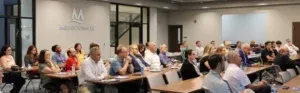
TATT funding partners, board members, and community partners enjoyed learning about the unique history of OneSpartanburg, Inc. and how the merger of the Chamber of Commerce, tourism, and economic development strengthened the organization’s collective capacity. This unified approach has accelerated economic development and expanded the meaningful impact OneSpartanburg delivers for Spartanburg County businesses and residents.
Thank you to President/CEO, Allen Smith, for presenting and hosting, and to Parker Poe for sponsoring the quarterly Pizza & Networking Series.
Our first TATT Chat of the year highlighted how tourism marketing drives economic growth across the Upstate of South Carolina by attracting visitors, talent, and businesses.
Heath Dillard, CEO of Visit Greenville, outlined the significant economic impact of tourism in Greenville County. In 2024, visitors generated a total economic impact of $2.5 billion, including more than $1.7 billion in direct spending at local businesses. Tourism supports one in every 25 jobs in the county and contributes over $200 million in state and local tax revenue. Visit Greenville’s marketing efforts influenced 1.5 million trips, producing a $453 million economic impact in fiscal year 2025. Visit Greenville public relations, social media growth, and digital engagement, resulted in approximately 15,000 website visits per day in 2025. Their sales team booked more than 270 events, resulting in 185,000 group room nights and over $150 million in economic impact. Major upcoming events include the SEC Women’s Basketball Tournament, NCAA Men’s Basketball First and Second Rounds, and Greenville’s appearance on Top Chef Carolinas.
Chief Tourism Development Officer, Billy Dunlap of OneSpartanburg, described their unique role as South Carolina’s only consolidated business, economic, and tourism development organization. Guided by its “Vision Plan,” OneSpartanburg focuses on talent, economy, and place. In 2025, Spartanburg secured $3.5 billion in capital investment across 20 projects, including the $500 million Project Core downtown development featuring Fifth Third Park. Sports tourism remains a major driver in Spartanburg, with 94 events generating $32 million in direct spending in the past fiscal year. The organization has also launched a new marketing campaign, “Take a Bite Out of the Berg,” along with a forthcoming “Experience Spartanburg” website and a new destination guide.
Kelly McQuarter, of Discover Greenwood, announced plans for a new destination center on Main Street, opening in April. Greenwood is advancing major projects such as Oregon Station, a food hall–style development with dining, entertainment, and outdoor concerts. A new campaign, “Only in Greenwood,” will highlight the area’s unique experiences, while sports tourism and targeted marketing tied to The Masters in Augusta continue to attract visitors. “Only in Greenwood,” will kick off with “Fresh Start Only in Greenwood” in the first quarter. This will be integrated into their new destination center and promoted at the Greenville Spartanburg International Airport.
Founded in 1978, Discover Upcountry focuses on encouraging visitation and spending across the broader region, reinforcing tourism as a cornerstone of the Upstate’s economy. Discover Upcountry Director, Tim Todd explains the organization’s regional role in promoting six Upstate counties Anderson, Cherokee, Greenville, Oconee, Pickens, and Spartanburg. This year the United States is celebrating our 250th anniversary. There were several key battles in the Upstate that changed the tide of the war. In fact, four of the six counties Discover Upcountry promotes are named after war generals. There is a continuing campaign to remember these battlegrounds as they are key historical sites in our region.
Measles has been a popular topic amongst the media, as cases have arisen across the Upstate. For our November TATT Chat, we were joined by Dr. Kandi Fredere from the South Carolina Department of Public Health. Dr. Fredere gave us an update on how healthy South Carolina is compared to the rest of the United States.
As of Nov. 12, 2025, there have been 46 confirmed cases of Measles in the Upstate, with 97% of those being unvaccinated residents. Between 2019-2020, only 92.1% of kindergartners were received the MMR vaccine. We suspect that the number of vaccinated children may be even lower now. Measles can have severe complications like pneumonia, and even death. To learn more about measles cases in the Upstate, prevention, and government response please visit SCDPH’s website by clicking here.
Currently South Carolina ranks 40th in the country for life expectancy after birth. The average life expectancy across the state is between 75.2-77.5 years old, with rural communities often seeing lower numbers. This correlates with the number of residents that are uninsured, with the largest number coming from rural and downtown communities. 35% of South Carolinians have a BMI of 30 or higher, ranking us 29th in the country for obesity. To combat these issues, there are nine priority areas that SCDPH is focused on. To learn more about this effort and view the 2024 annual report on state health, visit the link below.
Our November Resource Update was brought to us by Rebecca Maddox, Chief Executive Officer for the Phoenix Center. Since 1973, the Phoenix Center has been offering a safe place for people suffering from substance abuse to recover. It is primarily there for those who may not be able to afford to enter a recovery program. Out of 46 counties in South Carolina, only four of them have a publicly funded detox program. In 2024, the Phoenix Center helped 5,000 people with treatment, and another 21,000 in substance abuse prevention. Programs have been successful with an 82% reduction in alcohol abuse, and an 89% reduction in drug use. To learn more about the services offered by the Phoenix Center visit their website by clicking here.
Oct. 15, 2025, marks the 67th anniversary of the first flight at GSP International Airport in 1958. VP/Chief Marketing & Communications Officer, Tom Tyra, informed us about several upcoming projects concerning the airport.
Three million passengers travel through GSP every year. To accommodate this, the airport has made several improvements to make the visitor experience more seamless. One of the largest upcoming projects is the repaving of runway 4/22. 6,500 feet of runway will be repaved with asphalt, in addition to 11,001 feet of shoulder area, and the runway safety areas. It has been 17 years since the runway was paved, and 30 years since the shoulder has been addressed. The project is set to take place in 2026 in three phases starting on July 27-Sept. 4 with nightly runway closures. There will be two 72-hour full runway closures Sept. 11-13 and Sept. 18-20. The last phase is expected to take place from Sept. 14-Nov. 12 with nightly closures. This is the most efficient way to complete this project as it would take over 200 nights of partial closures to complete runway work.
Roadways into the airport have been upgraded as well as the addition of lanes in front of the terminal, increasing traffic efficiency. A new 1,500 space parking garage is expected to be fully operational by December 2025. Two passenger boarding bridges for gates A0 and B5 have been added to handle the increase in airport traffic. The facility is also updating all the seats, adding 20% seating capacity with charging stations. This is projected to be completed by the end of 2025. For more information regarding airport projects please visit https://gspairport.com/trip/.
During our TATT Chat, Gateway SC presented us with a resource update. Oct. 10, 2025, is World Mental Health Day. One in five adults have a mental health issue. To help combat this, Gateway utilizes the Clubhouse International model which focuses on building connections and viable skills. This is an excellent standard because it is internationally recognized and more cost effective than other treatment programs. For more information about how to support Gateway SC please visit https://gateway-sc.org/support-gateway/.
Our Sept. 11, 2025, TATT Chat focused on homelessness in the upstate. Keynote speakers Hannah Jarratt from A Place to Call Home, and Cody Carver from Greenville Together updated us with statistics, 2025 progress, and ways to support their mission.
A Place to Call Home is a Spartanburg based collective focused on sustainable housing. As of Jan. 1, 2025, there were 288 homeless people in Spartanburg County. Unfortunately, APTCH estimates that 65% of homelessness goes unreported, making the number of unhoused people significantly higher. Prevention, service, and housing are crucial steps in APTCH’s mission. A Way Home is a program operated by APTCH and The Faith Initiative to End Child Poverty. Around 90 days ago, they opened a family shelter in Spartanburg County. This filled a huge void as there were no family shelters currently available in the area. “We envision a Spartanburg County where homelessness is recognized as a solvable problem and where everyone has a safe, secure place to call home.”
Greenville Together is collaborative effort supported by United Way of Greenville, United Housing Connections, United Ministries, and the Triune Mercy Center. In Jan. 2025, Greenville Together estimated that there were 739 homeless people in Greenville County. Once again, the number is likely larger as homelessness often goes unreported. Greenville Together is utilizing a one-year, six-step action plan that includes accountability, public education, and training. The goal is to house 80 unsheltered households by the end of 2025. They also have a three-year, four-step comprehensive plan aimed at reducing homelessness amongst all populations. One of the ways to support Greenville Together is through their street counts. These are held on the last Thursday of the month. To participate in a street count email Cody Carver at ccarver@greenvilletogether.org.
For more information about A Place to Call Home and Greenville Together watch our Sept. TATT Chat and visit the websites below.